Let Me Give Light
A series of augmented reality experiments in giving light.
- Location
- New York, NY
- Year
- 2018
- Stack
- Unity 3D, Processing, ARKit, Photon Engine
Let Me Give Light is my graduate thesis at NYU ITP: a series of augmented reality projects that put ancient lighting in a modern context. I designed the concept and the interaction, and programmed three AR apps for iPad and iPhone.
Abstract
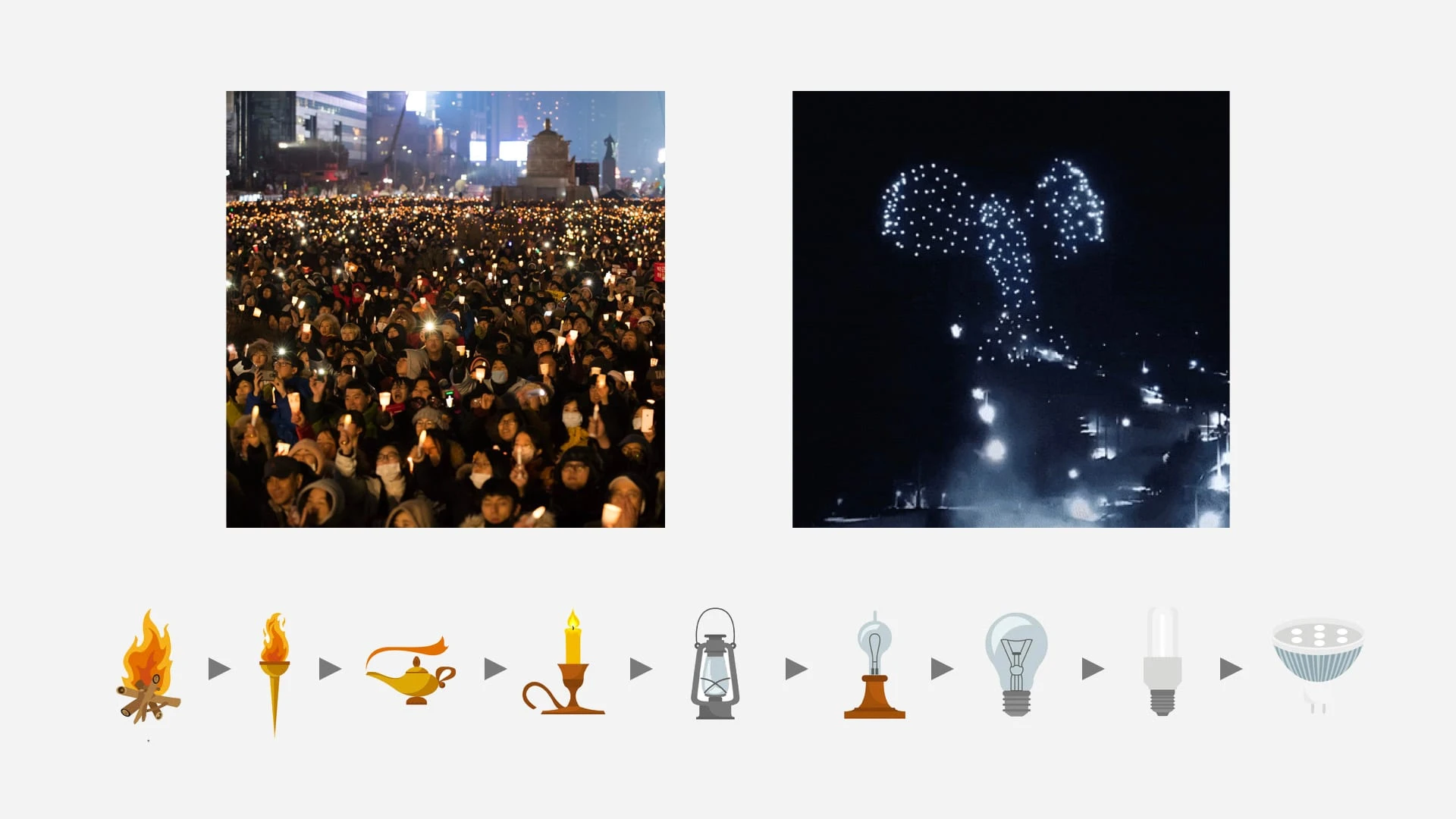
Lighting has changed over the past two centuries. The hardware has changed, and so has how we think about light. We take the light around us for granted, but fire held a central place in ancient religious belief, and candlelight is still widely used, from meditation to tributes and protests.
In South Korea, the Candlelight Movement brought millions of citizens into the streets, each holding a candle, to turn their anger at a corrupt government into a single political message. Two years later, the next government opened the PyeongChang Winter Olympics with a show of a thousand drones and LEDs, an image of peace that many Koreans took as a celebration of having come through those years. The oldest and the newest lighting technologies had both been used to carry what people felt.
So I asked how emerging technology could take on the restorative qualities of ancient light, and how that might move lighting toward something more meaningful.
Fire and candlelight carry emotional and spiritual messages in rituals and social movements. Taking that as a starting point, I ran three experiments in using modern lighting as a means of interaction between people and the space around them. Their titles come from a line in Shakespeare’s The Merchant of Venice, “Let me give light”: Let Me Give Light, Let Us Give Light and Let Us Give Candlelight. In the play the words mean something else, but they named the shift I wanted: lighting designed for people and the connections between them, not only for illumination.
Interaction design
Augmented reality is the means of giving light. Overlaying virtual elements on the physical room through a phone frees the light from the limits of the space, and connects us and our surroundings more seamlessly. Each of the three apps has its own interaction.
Let Me Give Light
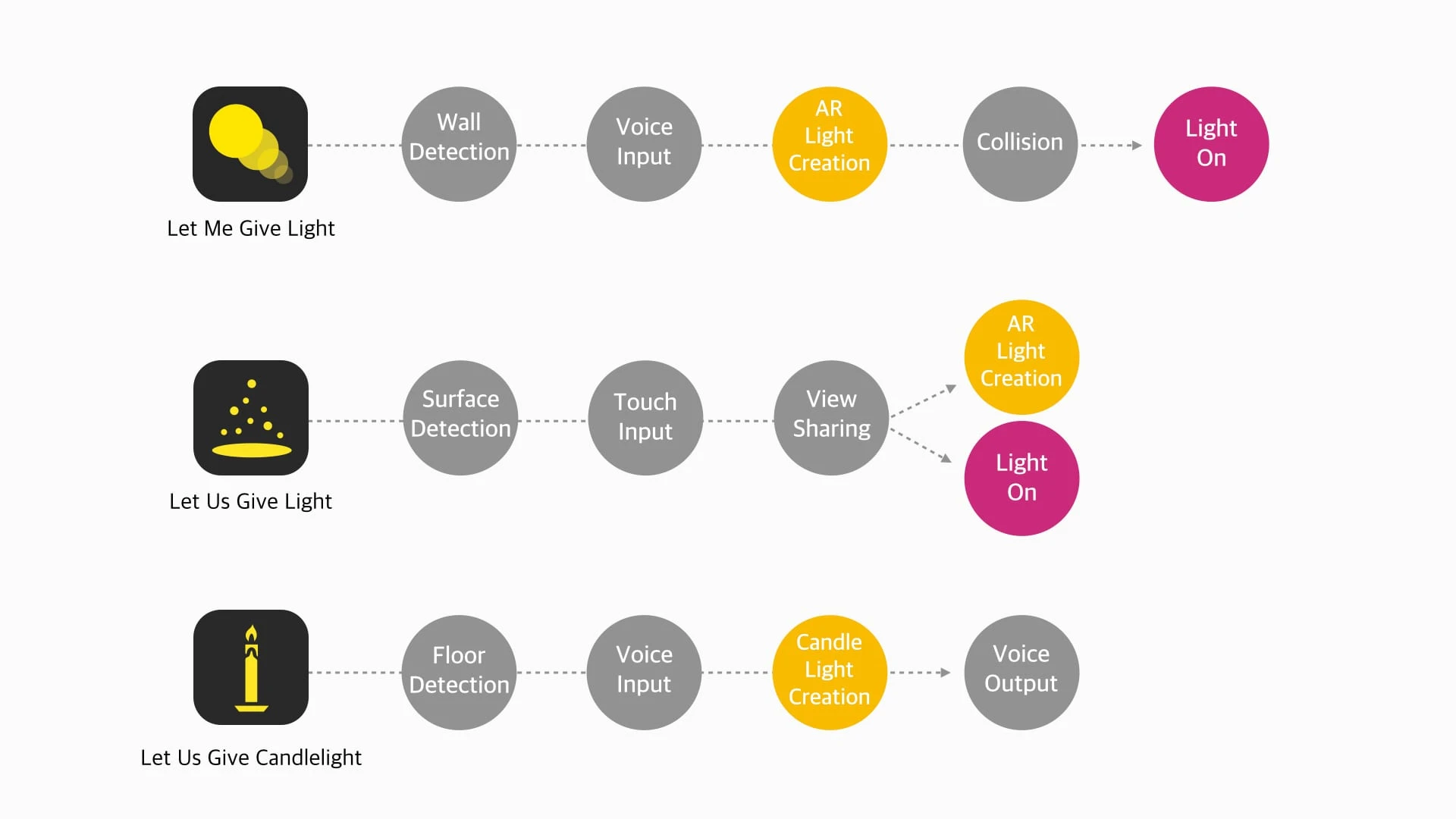
The first experiment gives meaningful interaction to an ordinary light bulb. It takes its cue from a flaming torch, which hands on heat directly and powerfully. Instead of speaking to a voice assistant or pressing a button, you blow into your phone to send light to a smart bulb.
ARKit detects the moment the virtual light, generated in Unity, meets the wall. The app then signals the Philips Hue network and the bulb comes on. The same gesture turns it off.
Research and development
The research focused on seamless communication between a phone and modern lighting through AR. After studying Philips Hue’s hardware setup and API, I controlled the light parameters from Unity scripts. I then worked through ARKit’s horizontal and vertical plane detection and the physics of the virtual light, and finally added sound input and graphic effects.
Let Us Give Light
The second experiment is an interactive light playground built around enlightenment and emotional connection.
You point the graphic indicator at a surface. ARKit recognizes the plane and anchors to it. Touching anywhere on the screen then creates a virtual light and a melodic sound at the same time. The physical lights inside react to every touch, and together they become a performance of interactive light.
Research and development
I designed a combination of light and opaque surface, built into a plant pot, that gives AR the best possible surface detection. A color-changing indicator shows users their status. I then worked on post-processing for visual quality and on physics simulation for dynamic motion. Photon Engine with Unity made it a networked space that several people can share at once.
Let Us Give Candlelight
The last experiment lets people leave wishes as augmented candlelight.
Pressing the red button records a wish, and a digital candle appears wherever the phone is pointing. Touching a candle that is already there plays its message back. This could become a permanent public sculpture, a successor to collective monuments like the love locks in Paris, which were removed because of their weight. With this technology, a collection like that can hold unlimited symbols, beyond the limits of time and space.
Special thanks to Tom Igoe, Younho Lee and Jeff Park.